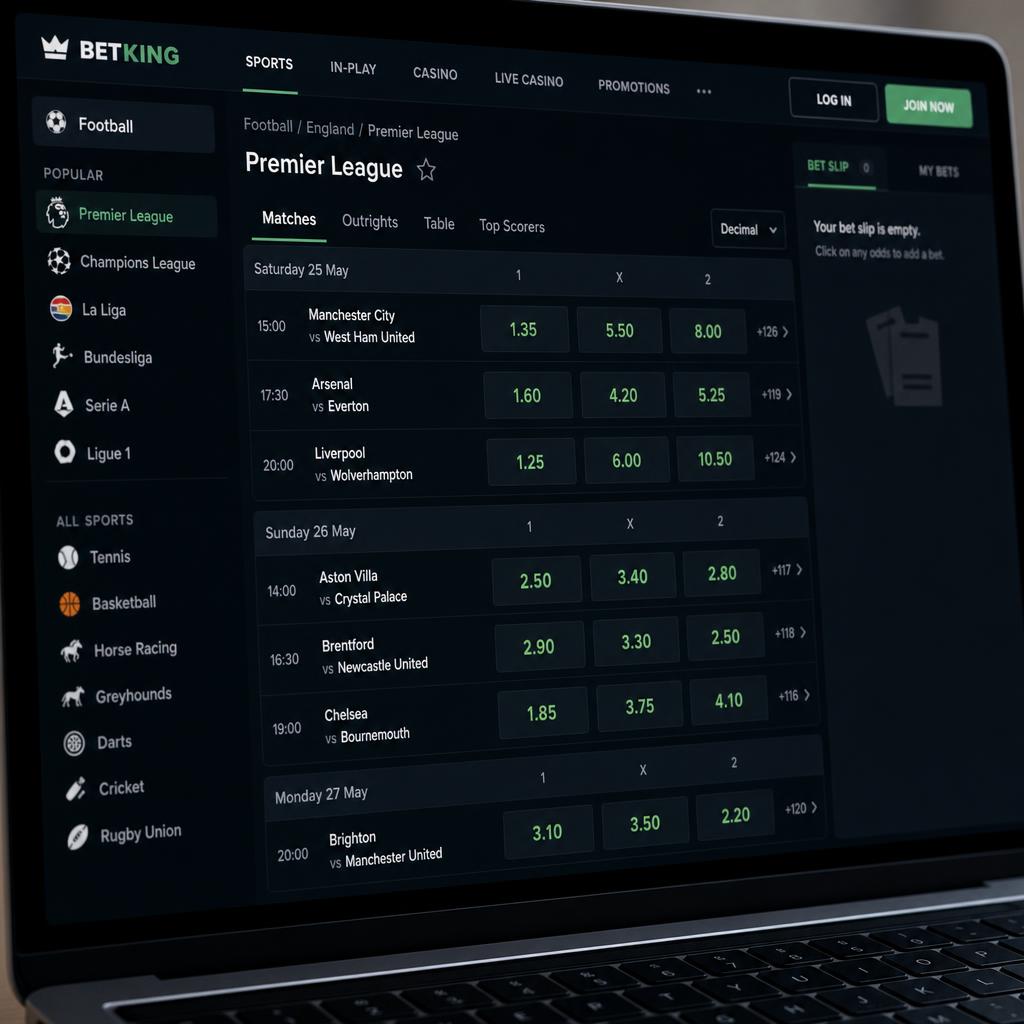
Before looking at the odds, write down what must happen for the ticket to win. A team can win while an over loses, and a striker can score while a handicap fails. Different selections on the same match are not interchangeable.
The scores and prices below are fictional teaching examples, not tips or evidence of a profitable system. Your bookmaker's rules govern your actual ticket.
How do over and under goals work?
A standard full-match total adds both teams' goals after 90 minutes plus stoppage time. Extra time and penalty shootouts normally do not count. Over 2.5 needs at least three goals; under 2.5 needs zero, one or two. A 2–1 result wins the over and loses the under. A 1–1 draw does the opposite.
The same method works at other half-goal lines. Under 4.5 wins with four goals or fewer, so 3–1 qualifies but 4–1 does not. Over 1.5 needs two or more goals; either team may score them. A half-goal total cannot push because a football match cannot finish with half a goal.
What happens on a whole-number or quarter-goal total?
An ordinary Asian over 3.0 wins with at least four goals, pushes with exactly three, and loses with two or fewer. Under 3.0 wins with two or fewer, pushes at three, and loses with four or more. A push normally returns the standalone stake; it is not a winning selection.
A quarter total splits the stake. Over 2.75 divides it equally between over 2.5 and over 3.0 at the quoted price. Exactly three goals wins the first half and refunds the second, producing a half-win. Do not apply half-goal settlement to a whole or quarter line.
What is an anytime goalscorer bet?
The named player must be officially credited with a qualifying goal in the stated period. A regular-time penalty normally counts. A penalty-shootout conversion does not, and an own goal is normally excluded from that player's anytime-scorer settlement. One qualifying goal is enough; a second does not ordinarily increase the payout.
Always check participation rules. A player who never takes the field may be void under the operator's terms. A substitute who appears can still be a losing selection if he does not score. Some special offers use different conditions, so do not assume that being listed in a squad guarantees either participation or a refund.
How does a same-game combination settle?
A full winning combination requires its selected conditions to win. For example, a team -2 Asian Handicap plus a named anytime scorer needs a victory by at least three goals and a qualifying goal from that player for both legs to win outright.
A victory by exactly two goals pushes the -2 handicap. If the player scores, that does not automatically make the original combination a full win. Depending on the product, the bookmaker may void, reduce or reprice the combination. Non-participation and abandoned-match rules also need checking.
Can I multiply the two individual prices?
Multiplying 1.72 by 1.56 gives 2.6832, or approximately 2.68. That arithmetic is not a confirmed same-game quote. A scorer goal and a large team victory can be correlated, so their individual prices cannot establish an independent combined probability.
The bookmaker may offer a different eligible price or refuse the combination. Only a price actually offered for the exact combined ticket is executable. A higher potential return does not mean the ticket is better value.
What should I check before placing the bet?
Confirm the exact sign, line, player and settlement period. Distinguish total match goals from team goals, and full-time markets from first-half markets. Check the starting lineup, participation terms, pushes, voids and whether the bookmaker permits the same-game combination.
Record the actual accepted selection and price rather than a research snapshot. None of these markets guarantees a return. If you cannot explain a losing score, a push and a winning score for the ticket, pause before risking money.
18+ only. Set an affordable loss limit, never chase losses, and pass when the rules or price are unclear.